

School Mathematics vs Mathematical Olympiads
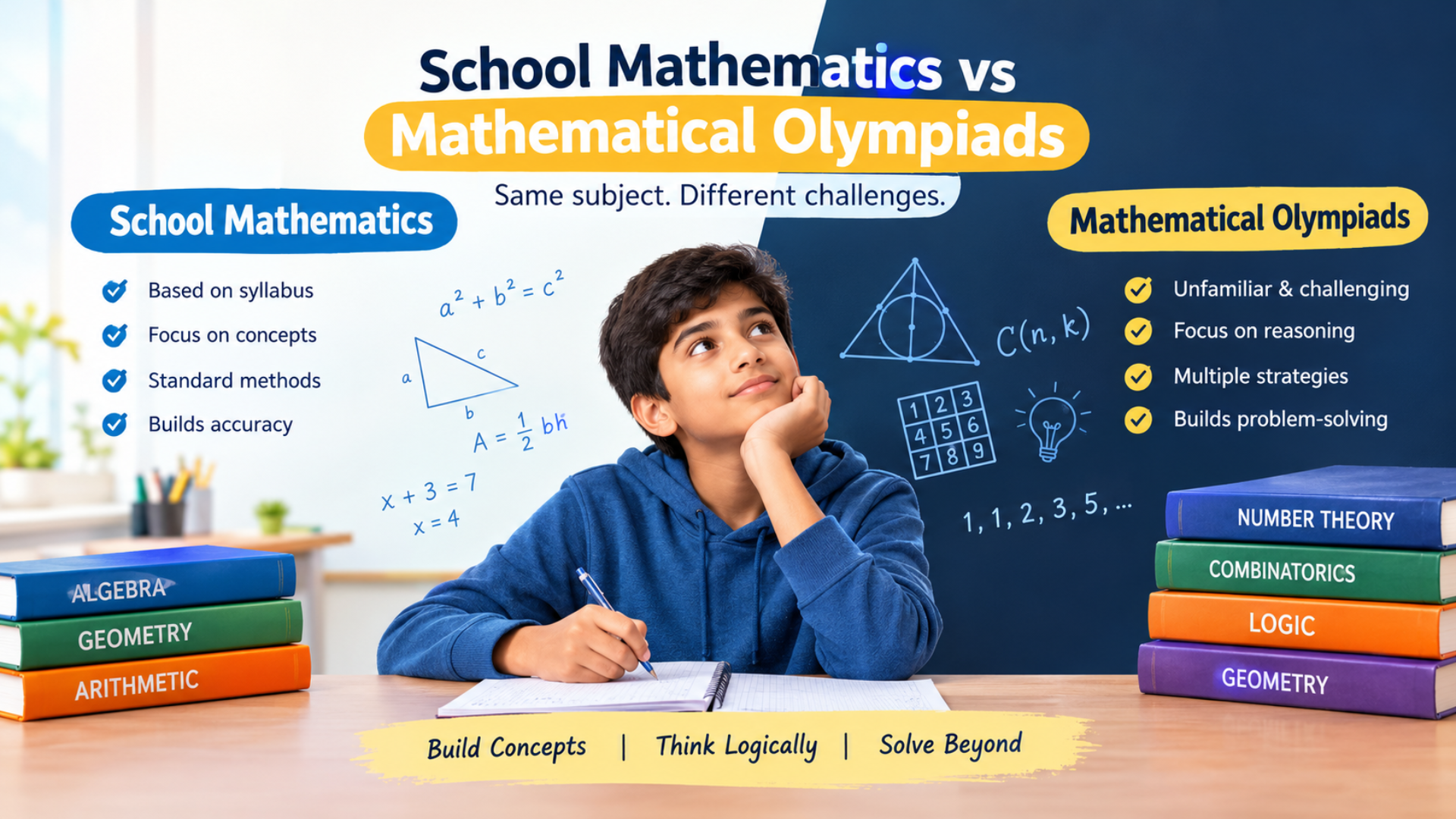
Is solving sums from textbooks sufficient to become a mathematics genius? Is there anything beyond formulas and calculations in mathematics?
There are many students who excel in school mathematics but struggle with Olympiad questions. There are also those who love solving difficult puzzles but find it hard to perform well in normal examinations. What causes this? The answer lies in the contrast between school mathematics and mathematics Olympiads.
Both have their own significance in developing mathematical skills, but they test students differently. Let’s find out how!
1. What Is School Mathematics ?
Mathematics education in schools is based on establishing the ideas of mathematics according to the school curriculum. The topics covered by mathematics are algebra, geometry, fractions, percentages, equations and arithmetic.
The ultimate aim here is to make sure that students understand mathematics concepts use mathematics formulas and answer mathematics questions correctly. This can be achieved through practice, homework and revision of mathematics lessons.
For example a student might need to solve a mathematics equation by using a mathematics formula or find the area of a mathematics triangle by following an approach.
The main emphasis in school mathematics is, on mathematics concepts, accuracy and syllabus based learning.
2. What Are Mathematical Olympiads ?
Olympiad Mathematics is a type of competition aimed at testing students’ skills in mathematics, creative and logical abilities. It is not like normal textbook questions in that students have to experiment with various methods until they find the right one.
The questions could be based on numbers, logical problems, geometry, combinatorics and mathematics itself.
For instance, in place of requiring the students to utilize a known formula, the Olympic question may require them to find a certain pattern or prove the correctness of a certain finding.
The central issue in mathematical Olympics is the capacity for problem solving and logical thinking.
3. School Mathematics vs Mathematical Olympiads: Key Differences
Even though both use math, their methodologies may differ greatly.
| School Mathematics | Mathematical Olympiads |
| Follows the prescribed school syllabus | May involve unfamiliar and challenging problems |
| Focuses on learning concepts and methods | Focuses on reasoning and creative approaches |
| Often uses standard problem-solving techniques | May require multiple attempts and strategies |
| Helps students perform well in school exams | Challenges students to think beyond routine questions |
| Regular practice builds accuracy | Analytical thinking builds problem-solving skills |
Both methodologies can work well together. A solid background in school math can help in solving more complicated problems.
4. Why Should Students Learn Both ?
Think of a student who has memorized all formulas but finds it difficult when the question is phrased differently. Think of another student who has an in-depth understanding of the concepts.
This is where the mathematical Olympiad training comes into play.
Knowledge of Olympiad mathematics can benefit students because:
- They will learn how to think logically and make links.
- Students will develop problem-solving skills.
- Confidence is built in solving difficult problems.
- Concepts of mathematics will be understood rather than memorised.
- Analytical skills can prove helpful in future competitions and education.
However, studying Olympiad mathematics must not come in place of school studies. This combination makes the learning process of mathematics much broader.
5. How Can Students Start Preparing for Mathematical Olympiads ?
Students do not have to be mathematical prodigies to get started. Curiosity, persistence, and the desire to learn are some good places to start.
Here are some helpful hints:
1. Build a strong foundation : Grasp school math before tackling tougher questions.
2. Do puzzles frequently : Practice solving number sequences, logic questions, and math puzzles.
3. Understand the reason for the answer : Instead of trying to memorize answers, understand why they are right.
4. Learn from mistakes : Go over your mistakes and try other ways to solve the question.
5. Progressively solve problems : Start with simple problems before moving onto tougher ones.
With consistent practice and proper guidance, students will eventually learn to be independent problem solvers.
Give Your Mathematical Thinking a New Direction with Vaze Classes
Mathematics is not only about arriving at the right answer but about thinking, analysing and solving problems with assurance.
With Vaze Classes, your child will be able to develop the necessary strength in mathematics as well as the logical abilities required for competitive tests and maths olympiads.
No matter whether your child wishes to do well in school or take up the challenge of the Mathematical Olympiad, concept building is the first step to success.
Do not forget: Every challenging problem is a chance to think out of the box and learn more!