

Category: Education

How to Improve Reasoning and Analytical Skills

How to Improve Reasoning and Analytical Skills for Talent Search Exams

Have you found yourself looking at a question and pondering how to get an answer because there is no formula to be applied? It is here that reasoning comes in handy.

Talent searches do not only assess the amount of knowledge students have gained through their textbooks. They evaluate the level of their critical thinking abilities, pattern recognition and problem solving skills.

It is obvious that for those students who plan to take such competitive tests as MTSE or scholarships, having these skills is very important. The good thing is that these skills can be developed and improved through consistent work.

Here are some of the techniques to develop them.

1. Practice Logical Reasoning Problems Every Day

Logical reasoning allows the students to analyze information and solve the problems through step-wise thinking.

The problems of number sequences, patterns, geometrical figures, direction sense and relation are some examples of the problems that can be used to practice logical reasoning.

One example of a number sequence is shown below:

2, 4, 8, 16, 32, ?

In the above sequence, it can be seen that each number is twice of the previous one, hence the answer will be 64.

2. Cultivate an Addiction for Solving Puzzles

Puzzles are exciting activities that enhance the thinking skills of the learners. The activities teach the learners how to look at a situation in various ways instead of using only one approach.

Examples of such activities include Sudoku, numbers puzzles, pictures puzzles, and brain teasers.

Spending just 10–15 minutes each day in solving puzzles can help foster curiosity and concentration.

3. Focus on Understanding, Not Memorising

A typical error committed by students while preparing for competitive exams is that of memorising the solution to problems without comprehending the concept behind them.

While attempting talent search examination papers, students can be faced with problems different from those practiced by them in their books.

Understanding of the reasoning behind a particular process enables students to apply the same concept even to new, difficult problems.

Conceptual understanding gives independence to students.

4. Enhance Observation Skills

Observation forms an essential part of analysis. At times, the little details in the question will assist the student to get to the right answer.

For example, the observation skills of a student can be enhanced through practice in picture-related questions, spotting differences, spotting missing figures and identifying number sequences.

It is also essential that a student develops the practice of going through the question before answering it.

5. Solving Previous Question Papers and Mock Tests

By solving previous years’ question papers and mock tests, students get to know the type of questions that are asked in the talent search exam.

This not only provides them an idea about the level of difficulty but also makes them accustomed to timed tests.

Once they finish a test paper, it is important for them to go through their answers and learn from their mistakes.

 It is more beneficial than just focusing on the marks gained.

6. Learn to Approach Problems in Different Ways

Every question does not have to be tackled by the way that comes to mind.

Let students try out ways of doing things and compare the results. The same mathematical question can be done using calculations, reasoning or patterns.

This will make students more adaptable when faced with questions.

7. Make Learning a Daily Habit

Thinking and analyzing skills take time to get better. You cannot become good at them overnight. You need to be steady and wait for progress.

A simple plan could be:

  • Practice reasoning questions for 10 minutes
  • Solve mathematical puzzles for 10 minutes
  • Work, on difficult problem solving exercises for 15 minutes

You should not try to solve hundreds of questions in one day; instead you should focus on understanding a few questions.

Why Is the Skill of Reasoning and Analysis Necessary for Talent Hunt Tests?

Talent hunt tests make students think beyond the confines of classroom teaching. Such tests make students acquire skills which are not only helpful in competitive tests but are also helpful in their day-to-day lives and in future studies.

Reasoning skills would help the students understand problems better and also make connections between the concepts to solve them on their own.

Reasoning skills will also increase their confidence level in solving tough questions.

Build Strong Thinking Skills with Vaze Classes

All individuals have the capacity to think, to question and learn. However, what it takes to be able to do that effectively is proper guidance and practice.

At Vaze Classes, students can work to build upon their mathematical skills and improve their logical reasoning and problem solving skills that will help them in taking the scholarship and talent search examination.

Bear in mind that solving examination questions isn’t all about getting the answers correct. In addition, it’s about learning how to think, analyze and solve each problem.

Practice today, as each question that you solve makes you a better thinker!
Read More

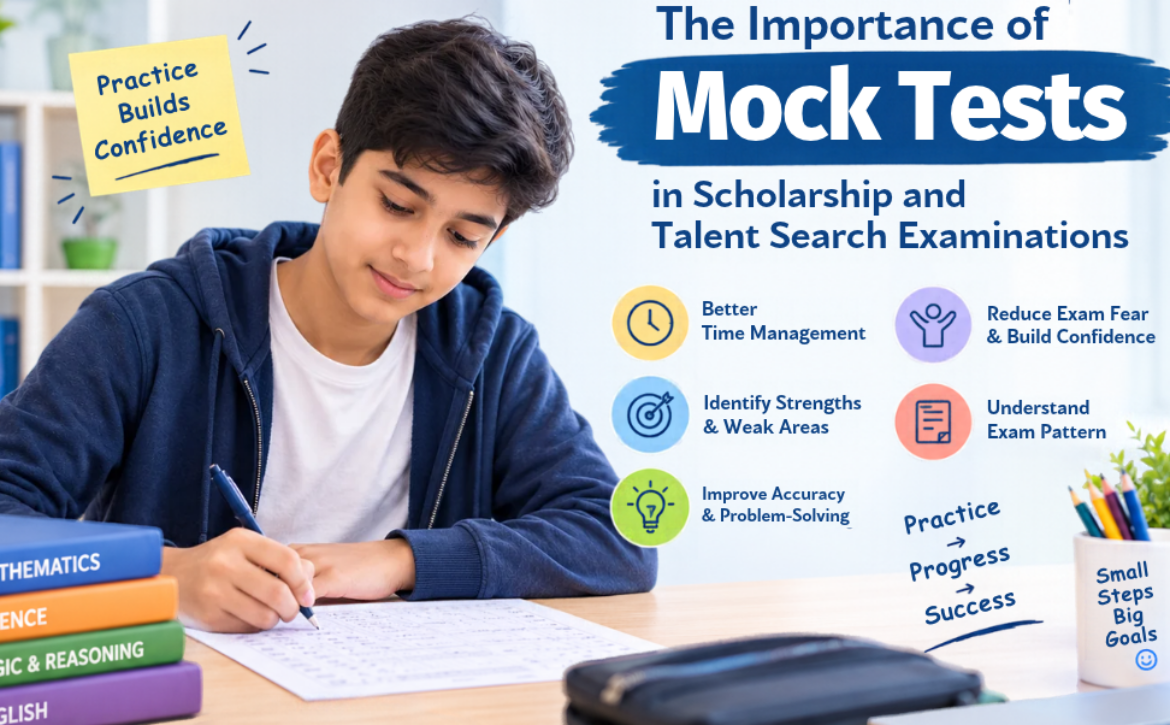
The Importance of Mock Tests

The Importance of Mock Tests in Scholarship and Talent Search Examinations

Getting ready for a scholarship or talent search test is not about reading books or memorising answers. Students need to learn how to stay calm under pressure use their time wisely and answer types of questions, with confidence. That’s where mock tests become very useful. They give students a feel of the actual exam and help them understand what to expect.

Regardless of whether the student is gearing up for a scholarship test, MTSE or any other talent search test, consistent practice through mock tests can help organise exam preparations better for the students.

What Are Mock Tests ?

Mock exams let students practise in a setting that feels like the exam. Mock exams use the question format the same marking pattern and the same time limit.

By solving tests students can understand the examination format and identify the areas where students need more practice. Students also get an opportunity to apply what students have learned of simply revising the same topics repeatedly.

5 Reasons Why Mock Tests Are Important for Students

1. Help Students Manage Time Better

Time management is something many students struggle with when taking exams. Some questions can be answered in a few seconds. Other questions need thinking.

Mock tests help students learn how to split their time among questions. Through practice they can figure out when to keep going, when to go back to a hard question and how to finish the test in the time they have.

2. Identify Strengths and Weak Area

A student can be really good at math. Might struggle with logic or science questions. It’s not easy to see these problems unless someone checks their abilities.

Mock tests help students see which topics they have mastered and which ones need work. After taking them students can focus more on the parts instead of going over everything the same way. This way they use their time better. Get stronger in the areas they struggle with. It’s like a check-up for their learning.

3. Improve Accuracy and Problem-Solving Skill

While having knowledge of the answer is crucial in scholarship and talent search tests choosing the right answer is just as important.

Regular practice makes it easier for students to get used to types of questions. Looking at the answers that were wrong also helps them see where they made a mistake whether it was because they didn’t understand the idea made a math error or didn’t read the question correctly.

Over time this approach can improve accuracy and problem-solving ability.

4. Reduce Exam Fear and Build Confidence

Some students know their subjects well but feel very anxious when they take an exam. They might be worried, about running out of time facing questions they don’t recognize or making errors.

Mock tests help students get used to taking exams under time limits before the real test day comes. As they practice more they start to feel more ready to deal with the stress of exams.

Confidence develops gradually through preparation, practice and learning from mistakes.

5. Help Students Understand the Exam Pattern

Every competitive exam has its way of asking questions its own level of difficulty and its own way of giving marks. Students need to know these things before they take the exam.

Mock tests aid them in practicing various types of questions and also teach them how to answer the question paper. Nevertheless it is important that the students always refer to the examination rules since sometimes the practice paper might be slightly different from the real one.

How Should Students Use Mock Tests Effectively?

Taking one mock test after another will not suffice. The students have to gain some knowledge from these tests for the practice to be worthwhile.

Here are a few simple steps:

• Clock your time: Take the test as if you were taking the real test.

• Mark all your answers: Check your answers regardless if it is right or wrong.

• Determine why you made mistakes: Find out what part of the problem causes you difficulties – if it is due to concept, arithmetic or time management.

• Study harder on your difficult subjects: Go back to the chapter that gave you trouble and solve more questions on that topic.

• Self-evaluate yourself: See how much you have improved through time.

Students should concentrate on getting better of only worrying about their scores. Even a low score can still be useful if it helps students see what to work on next.

Prepare Smarter with Vaze Classes

Scholarship and talent search examinations give students a chance to test their knowledge and grow thinking. With the preparation regular practice and proper guidance students can face scholarship and talent search examinations with more confidence.

At Vaze Classes students can work on strengthening their concepts and building the skills required for examinations. Mixing classroom learning, regular practice and careful revision helps students prepare in an organized way.

Remember, every mock test is a chance to learn something new. The goal is not just to score better in practice tests but to become better prepared for the actual examination.

Read More

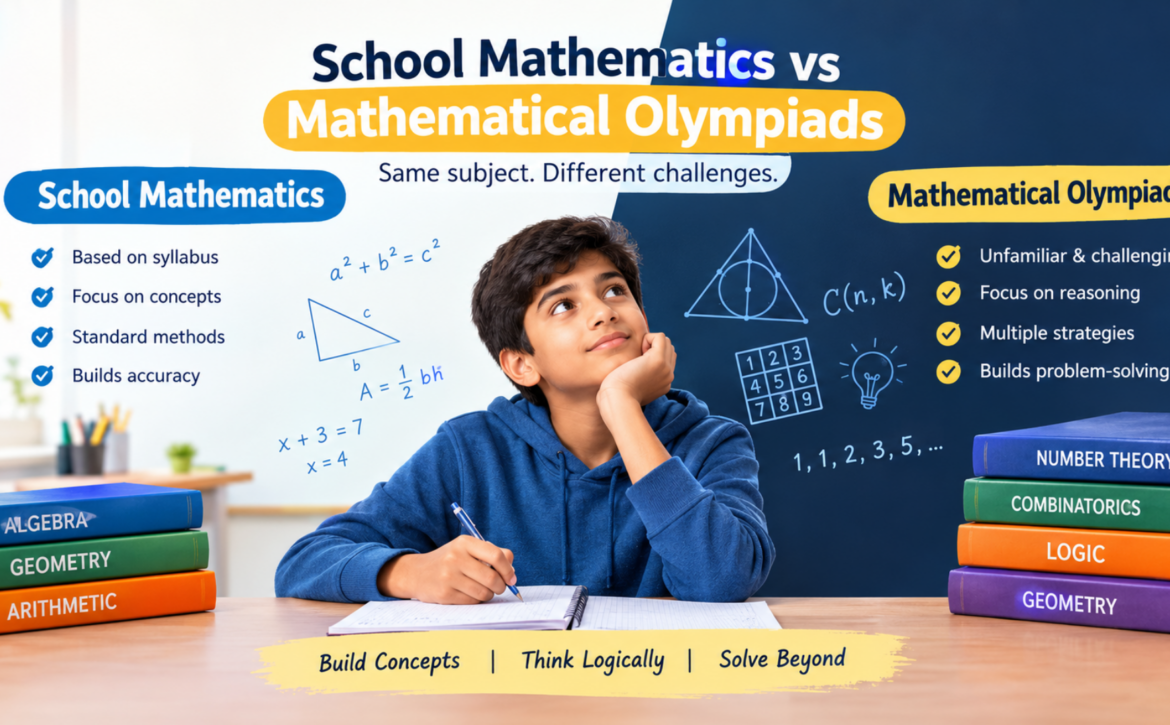
School Mathematics vs Mathematical Olympiads

Is solving sums from textbooks sufficient to become a mathematics genius? Is there anything beyond formulas and calculations in mathematics?

There are many students who excel in school mathematics but struggle with Olympiad questions. There are also those who love solving difficult puzzles but find it hard to perform well in normal examinations. What causes this? The answer lies in the contrast between school mathematics and mathematics Olympiads.

Both have their own significance in developing mathematical skills, but they test students differently. Let’s find out how!

1. What Is School Mathematics ?

Mathematics education in schools is based on establishing the ideas of mathematics according to the school curriculum. The topics covered by mathematics are algebra, geometry, fractions, percentages, equations and arithmetic.

The ultimate aim here is to make sure that students understand mathematics concepts use mathematics formulas and answer mathematics questions correctly. This can be achieved through practice, homework and revision of mathematics lessons.

For example a student might need to solve a mathematics equation by using a mathematics formula or find the area of a mathematics triangle by following an approach.

The main emphasis in school mathematics is, on mathematics concepts, accuracy and syllabus based learning.

2. What Are Mathematical Olympiads ?

Olympiad Mathematics is a type of competition aimed at testing students’ skills in mathematics, creative and logical abilities. It is not like normal textbook questions in that students have to experiment with various methods until they find the right one.

The questions could be based on numbers, logical problems, geometry, combinatorics and mathematics itself.

For instance, in place of requiring the students to utilize a known formula, the Olympic question may require them to find a certain pattern or prove the correctness of a certain finding.

The central issue in mathematical Olympics is the capacity for problem solving and logical thinking.

3. School Mathematics vs Mathematical Olympiads: Key Differences

Even though both use math, their methodologies may differ greatly.

School MathematicsMathematical Olympiads
Follows the prescribed school syllabusMay involve unfamiliar and challenging problems
Focuses on learning concepts and methodsFocuses on reasoning and creative approaches
Often uses standard problem-solving techniquesMay require multiple attempts and strategies
Helps students perform well in school examsChallenges students to think beyond routine questions
Regular practice builds accuracyAnalytical thinking builds problem-solving skills

Both methodologies can work well together. A solid background in school math can help in solving more complicated problems.

4. Why Should Students Learn Both ?

Think of a student who has memorized all formulas but finds it difficult when the question is phrased differently. Think of another student who has an in-depth understanding of the concepts.

This is where the mathematical Olympiad training comes into play.

Knowledge of Olympiad mathematics can benefit students because:

  • They will learn how to think logically and make links.
  • Students will develop problem-solving skills.
  • Confidence is built in solving difficult problems.
  • Concepts of mathematics will be understood rather than memorised.
  • Analytical skills can prove helpful in future competitions and education.

However, studying Olympiad mathematics must not come in place of school studies. This combination makes the learning process of mathematics much broader.

5. How Can Students Start Preparing for Mathematical Olympiads ?

Students do not have to be mathematical prodigies to get started. Curiosity, persistence, and the desire to learn are some good places to start.

Here are some helpful hints:

1. Build a strong foundation : Grasp school math before tackling tougher questions.

2. Do puzzles frequently : Practice solving number sequences, logic questions, and math puzzles.

3. Understand the reason for the answer : Instead of trying to memorize answers, understand why they are right.

4. Learn from mistakes : Go over your mistakes and try other ways to solve the question.

5. Progressively solve problems : Start with simple problems before moving onto tougher ones.

With consistent practice and proper guidance, students will eventually learn to be independent problem solvers.

Give Your Mathematical Thinking a New Direction with Vaze Classes

Mathematics is not only about arriving at the right answer but about thinking, analysing and solving problems with assurance.

With Vaze Classes, your child will be able to develop the necessary strength in mathematics as well as the logical abilities required for competitive tests and maths olympiads.

No matter whether your child wishes to do well in school or take up the challenge of the Mathematical Olympiad, concept building is the first step to success.

Do not forget: Every challenging problem is a chance to think out of the box and learn more!

Read More

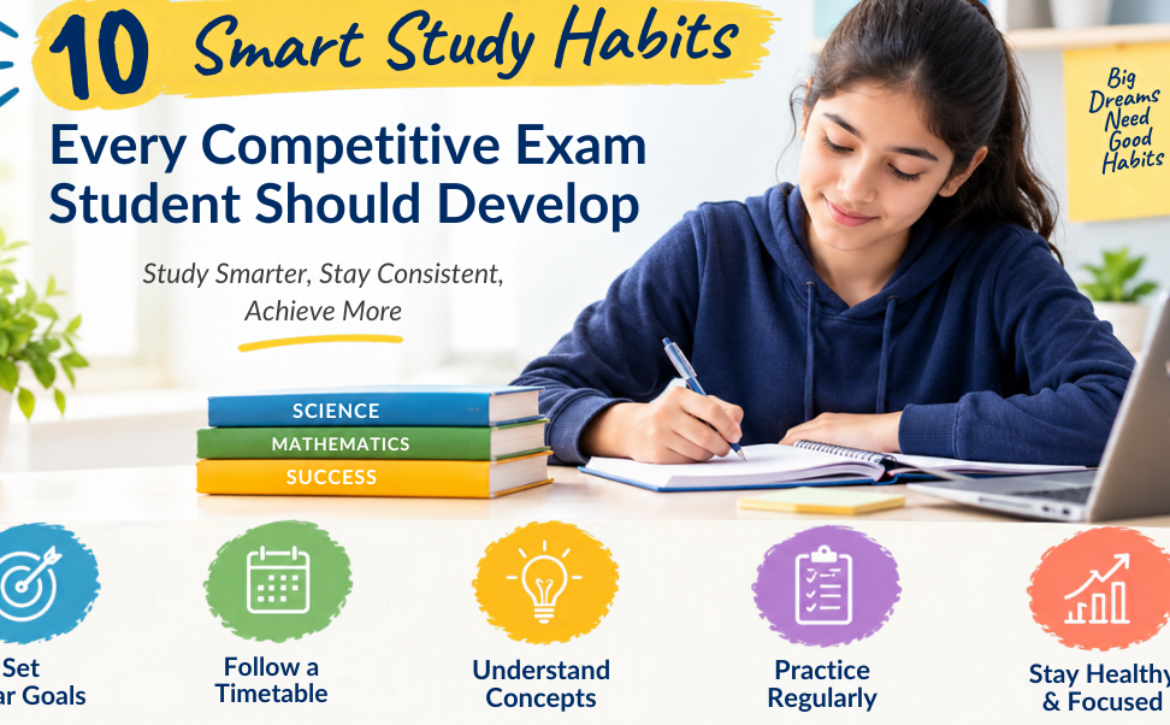
10 Smart Study Habits Every Competitive Exam

Study Smarter, Stay Consistent, Achieve More

Preparing for an entrance examination is not only about studying for long periods of time. It is also about studying with the correct method, consistency, and concentration. For students in schools who prepare themselves for the examinations like Olympiads, scholarship examinations, MTSE, Homi Bhabha, and others, it would be beneficial to develop proper study habits.

Here are 10 smart study habits every competitive exam student should develop.

1. Set Clear Study Goals 🎯

Before beginning any study session, start with an objective. Rather than saying “I will study Science,” determine what you intend to do within that session, whether completing a chapter, answering questions, or learning a topic.

2. Follow a Realistic Study Timetable

An efficient time table will help the student maintain balance between school, study, revision, preparation for competitive exams, and leisure. Prepare a time table that suits you instead of spending very long hours on studies.

3. Focus on Understanding Concepts

The exams that are based on competition usually check the application skills of a student. Students should concentrate on knowing the “why” and “how” of each and every topic.

With the help of Vaze Classes, you will be able to understand Science and Mathematics better in preparation for any competitive exam.

4. Practise Questions Regularly ✏️

Practice is one of the most important parts of competitive exam preparation. Solve different types of questions and gradually increase the difficulty level.

5. Make Short Revision Notes

Create simple notes containing important formulas, definitions, concepts and shortcuts. These notes can become useful when revising before tests and examinations.

6. Take Regular Mock Tests

Mock tests help students understand their preparation level and become familiar with exam-style questions. After every test, spend time analysing mistakes instead of only checking the score.

7. Learn From Your Mistakes

Incorrect answers provide an opportunity for learning. Have a mistake book where you record questions that you answer incorrectly and the reason why and the right way.

8. Avoid Distractions 📵

Distractions like mobile phones, social media, and other unnecessary notifications could be a disturbance to your concentration. You should avoid such distractions when studying and create a quiet environment.

9. Revise at Regular Intervals

Students should not wait for the last few days before their exams to go through everything. Revision will help them understand the concepts easily and know the areas that require further practice.

10. Take Care of Your Health

Other ways to prepare well include taking enough sleep, eating well, being active, and even taking small breaks. This will assist students in remaining alert during their studies.

Smart Habits Build Strong Foundations

Success in competitive exams does not happen in one day but requires consistent hard work, proper practice, good concept development, and revision.

With proper guidance and teaching methodology, students can learn to build these qualities and be successful learners. Vaze Classes believes in building up the concepts of the students in order to make them ready for competitive exams at the school level.

Remember: Don’t just study harder—study smarter!

Read More

10 Smart Study Habits Every Competitive Exam Student Should Develop

Study Smarter, Stay Consistent, Achieve More

Preparing for an entrance examination is not only about studying for long periods of time. It is also about studying with the correct method, consistency, and concentration. For students in schools who prepare themselves for the examinations like Olympiads, scholarship examinations, MTSE, Homi Bhabha, and others, it would be beneficial to develop proper study habits.

Here are 10 smart study habits every competitive exam student should develop.

1. Set Clear Study Goals 🎯

Before beginning any study session, start with an objective. Rather than saying “I will study Science,” determine what you intend to do within that session, whether completing a chapter, answering questions, or learning a topic.

2. Follow a Realistic Study Timetable

An efficient time table will help the student maintain balance between school, study, revision, preparation for competitive exams, and leisure. Prepare a time table that suits you instead of spending very long hours on studies.

3. Focus on Understanding Concepts

The exams that are based on competition usually check the application skills of a student. Students should concentrate on knowing the “why” and “how” of each and every topic.

With the help of Vaze Classes, you will be able to understand Science and Mathematics better in preparation for any competitive exam.

4. Practise Questions Regularly ✏️

Practice is one of the most important parts of competitive exam preparation. Solve different types of questions and gradually increase the difficulty level.

5. Make Short Revision Notes

Create simple notes containing important formulas, definitions, concepts and shortcuts. These notes can become useful when revising before tests and examinations.

6. Take Regular Mock Tests

Mock tests help students understand their preparation level and become familiar with exam-style questions. After every test, spend time analysing mistakes instead of only checking the score.

7. Learn From Your Mistakes

Incorrect answers provide an opportunity for learning. Have a mistake book where you record questions that you answer incorrectly and the reason why and the right way.

8. Avoid Distractions 📵

Distractions like mobile phones, social media, and other unnecessary notifications could be a disturbance to your concentration. You should avoid such distractions when studying and create a quiet environment.

9. Revise at Regular Intervals

Students should not wait for the last few days before their exams to go through everything. Revision will help them understand the concepts easily and know the areas that require further practice.

10. Take Care of Your Health

Other ways to prepare well include taking enough sleep, eating well, being active, and even taking small breaks. This will assist students in remaining alert during their studies.

Smart Habits Build Strong Foundations

Success in competitive exams does not happen in one day but requires consistent hard work, proper practice, good concept development, and revision.

With proper guidance and teaching methodology, students can learn to build these qualities and be successful learners. Vaze Classes believes in building up the concepts of the students in order to make them ready for competitive exams at the school level.

Remember: Don’t just study harder—study smarter!

Read More

How to Prepare for MTSE: A Simple Guide

Preparing for the Maharastra Talent Search Examination (MTSE) is one of the most important academic steps for students in Class 8, 9, and  10 who wish to perform well on competitive exams. The MTSE is well known for its rigorous evaluation of critical thinking conceptual understanding and problem-solving skill. Despite the test’s apparent difficulty having a solid preparation strategy is essential. At Vaze Classes, we think that every student can achieve their maximum potential with a well-defined plan and a guided approach. Everything you need to successfully prepare for the MTSE and increase your chances of receiving a high score is covered in this straightforward guide.

1. Understand the MTSE Exam Structure 

It is essential to comprehend how the test operate before beginning your preparation. MTSE is conducted in two stages and consists of two major sections:

• Mental Ability Test (MAT)

This section evaluate logical reasoning, critical thinking, spatial awareness and pattern recognition. MAT tests your ability to think beyond textbook.

• Scholastic Aptitude Test (SAT)

This include Mathematic, Science and Social Science based on the syllabus. It check how well you understand and apply academic concepts.

Knowing the structure helps you prepare with direction and avoid unnecessary confusion on what to study.

2. Create a Realistic Study Plan

The secret to successful MTSE preparation is a well-organized schedule. Depending on your strengths split your study time between the MAT and SAT.

  • Assign more time to topics you find difficult
  • Make weekly and monthly goals
  • Keep 1–2 hours daily for revision
  • Include time for self-assessment tests

Consistency matter more than the number of hours. A planned approach ensures slow but steady progress.

3. Strengthen Your Basics

MTSE questions are concept-oriented. Without strong fundamentals, solving advanced-level questions becomes difficult.

  • Revise MCERT Class 8, 9 and 10 thoroughly
  • Understand concepts instead of memorising them
  • Practice numerical problems regularly
  • Clarify doubts immediately to avoid confusion later

When your basics are clear, you naturally solve challenging questions with greater accuracy and confidence.

4. Solve Mock Tests & Previous Year Papers

The best way to gauge your preparedness is through mock exam

  • Practice full-length tests weekly
  • Solve previous year MTSE papers
  • Analyse mistakes to identify weak areas
  • Work on speed and accuracy

Regular practice simulates the real exam environment and help reduce exam-day stress while strengthening your problem solving ability.

5. Improve Reasoning Skills for MAT

MAT often decides overall performance because it requires sharp analytical thinking.

To score high:

  • Solve puzzles, series, analogies, and coding-decoding questions
  • Practice reasoning for 20–30 minutes daily
  • Learn shortcuts for faster solving

Continuous reasoning practice makes MAT scoring and helps build a strong logical mindset.

6. Take Expert Guidance

Professional coaching provides structure, direction, and effective learning techniques. At VazeClasses, students get:

  • MTSE-focused teaching modules
  • Experienced faculty support
  • Doubt sessions & chapter-wise tests
  • High-quality study material
  • Personalized performance feedback

Guidance ensures you always move in the right direction with confidence.

7. Stay Consistent and Confident

Cracking MTSE requires steady preparation, positive thinking and discipline. Avoid last min rush, revise regular and maintain a calm mindset. Enhancing overall performance is largely dependent on confidence.

Final Thoughts

MTSE preparation becomes much easier with a planned strategy, strong concepts and the right guidance. With dedicated effort and the support of VazeClasses you can confidently approach the exam and achieve the result you aim for. Start early, stay focused and keep improving the path to success is your to take.

Read More

Homi Bhabha Competitive Exam

For a lot of young people the Homi Bhabha Balvaidnyanik Competition is the spark that awakens the curiosity that all great scientists have. One of the most popular science contests in Maharashtra, it aims to encourage scientific aptitude in students. It’s more than just a test it’s a chance to investigate try things out and get a taste of science outside of textbooks.

And to help students shine in this journey, Vaze Classes provides expert guidance and practical training that make preparation smarter and more effective.


🌟 What is the Homi Bhabha Exam?

The Dr. Homi Bhabha Balvaidnyanik Competition conducted by the Mumbai Science Teachers’ Association is designed for students of Classes 6th and 9th.
It seeks to inspire young students to develop a practical approach to learning and a scientific mindset. Students learn science through experiments and logical reasoning just like actual scientists do thanks to the exam’s written assessments, practicals and interviews.

At Vaze Classes, students get the right foundation through concept-based teaching, -experiment sessions, and personalized mentorship.


🧪 Exam Structure

The competition is held in three main stages:

1. Written Test (Theory):
The test includes multiple-choice questions from the current and previous year’s science syllabus assessing your conceptual clarity and application skills.

2. Practical Test:
Students perform simple experiments to test observation skills, accuracy, and reasoning — making learning hands-on and fun.

3. Viva/Interview Round:
A short question-answer session that helps evaluate your curiosity, communication, and confidence in science concepts.

Vaze Classes ensures that students are well-prepared for each of these stages through interactive practice sessions and regular assessments.


🎯 How to Prepare for the Homi Bhabha Exam

Preparing for this exam isn’t about memorizing; it’s about understanding and applying. Here are some smart ways to get ready:

  •  Strengthen Fundamentals:
    Go over your school syllabus in detail paying particular attention to the ideas in biology, chemistry and physics.
  • Solve Past Papers:
    To become acquainted with the format and degree of difficulty of the questions practice answering previous question papers.
  • Participate in a Good Guidance Program:
    Enroll in Vaze Classes’ Homi Bhabha Guidance Course where knowledgeable mentors offer practice with experiments, mock exams and sessions for clearing up doubts.
  • Emphasis on Practical Knowledge:
    Learn via projects, models and experiments this makes concepts easier to recall.
  • Remain Inquisitive:
    Examine how science functions in daily life, read science magazines and view instructional videos.

💡 Benefits of the Homi Bhabha Exam

Beyond grades and awards, there are a number of benefits to competing in the Homi Bhabha Balvaidnyanik competition:

🏆 Develops Confidence: Assists you in presenting your concepts and experiments to experts with assurance. Fosters Scientific Thinking: Promotes reason, logic and curiosity.
📚 Enhances Academic Performance: The profound comprehension acquired aids in school assessments and upcoming competitive tests such as the NTSE and Olympiads.
🎓 Acknowledgment and Awards: Successful students receive medals, certificates and state-level recognition which is a proud accomplishment for both students and schools.
🚀 Solid Basis for Upcoming Research: A strong foundation for higher education is created by early exposure to scientific research and experiment-based learning.


🌱 Why Choose Vaze Classes for Homi Bhabha Guidance

A proper guidance course makes preparation easier and more effective. Vaze Classes offers a structured approach that ensures success through:

✅ Expert mentors with years of experience
✅ Regular tests and performance tracking
✅ Hands-on training for practical rounds
✅ Concept-based learning rather than rote learning
✅ Motivation and confidence-building sessions

With Vaze Classes, students gain both knowledge and confidence — making the learning process enjoyable and result-oriented.


✨ Final Thoughts

The Homi Bhabha Competitive Exam is a voyage of discovery, inquisitiveness and creativity rather than merely a science test. You get closer to becoming a true scientist with each experiment you conduct and each question you respond to.

Begin your training with Vaze Classes, maintain your curiosity, and allow your aspirations to become scientists to come true. You might be the next big innovator!


Read More

Mahuli, Mamnoli, and Kaas Plateau

Mahuli, Mamnoli, and Kaas Plateau: The Ideal Outdoor Learning Trips for Students

The finest time for students to leave their classrooms and get hands-on experience with nature is during the monsoon season, when Maharashtra comes to life.

Monsoon educational tours in Maharashtra transform simple excursions into worthwhile educational opportunities by trips to locations like Mahuli, Mamnoli, and Kaas Plateau.

Mahuli: History and Geography Come Alive

One of the greatest outdoor experiences for students is Mahuli which is close to Asangaon and provides the ideal balance of adventure nature and hands-on learning. The hike through thick forests and slick rocks turns into a fascinating lesson in the formation of hills and plateaus when it rains. The chilly mist and expansive vistas teach students about the local flora and fauna while the fort ruins at the summit narrate history of the Marathas. Beyond the classroom geography history and environmental science come to life here. Monsoon educational tours in Maharashtra often include Mahuli for this very reason.

Mamnoli: Learning From Village Life

Mamnoli a quiet village near Titwala offers a glimpse into rural Maharashtra. Here students watch farmers work in paddy fields and learn how crucial the monsoon is for agriculture. They see how villages manage water build homes suited for heavy rain and live closely with nature helping them appreciate sustainable living and the importance of farming. This makes Mamnoli one of the best outdoor trips for students where they can experience firsthand the balance between people and the environment gaining lessons in simplicity and resilience that classroom walls cannot provide.

Kaas Plateau: A Lesson in Biodiversity

By September, the Kaas Plateau near Satara transforms into a stunning sea of wildflowers earning it the name “Maharashtra’s Valley of Flowers”. Rich in rare kinds of plants and teeming with pollinators all it is recognized as a UNESCO World Natural Heritage site. Students gets knowledge of ecosystems biodiversity and the importance of preserving these areas for the wellbeing of our planet.

Why These Trips Matter

Together Mahuli, Mamnoli and Kaas Plateau offer lessons in geography, history agriculture and environmental science — all in real life. Monsoon educational tours in Maharashtra often highlight these locations for their immersive value. These outdoor trips turn theory into experience teaching students to observe explore and care for the natural world, making their learning truly memorable.
Read More

The Right Math Mentorship for Your Child – From MAT to IMO

The Right Math Mentorship for Your Child – From MAT to IMO

Why Choose This Institute?

Are you a parent of a bright young student who loves mathematics? Or perhaps your child finds math a little intimidating and needs a positive, confidence-boosting environment to grow? If you’re from Dombivli, Kalyan, or nearby areas, we’ve found the perfect place for your child to build a strong mathematical foundation. Math Olympiad coaching near Dombivli is also an excellent option to support their growth.

For the past 32 years, this esteemed institute has been transforming how students from Std. V to Std. VIII perceive mathematics. Their mission? To eliminate math phobia and create a generation of students who enjoy and excel in mathematics through well-designed competitive exams like MAT (Maths Aptitude Test) and JMO (Junior Maths Olympiad).

What sets the Institute apart is that it does more than only impart knowledge. Its main goal is to boost children’s self-esteem in their capacity for competitive thinking, problem-solving, and logical thought. Math Olympiad coaching near Dombivli also helps build these skills. As a stepping stone to more challenging exams like Pre-RMO, RMO, INMO, MTSE, NTSE, and IMO, these tests are given in two levels (MAT and JMO).

Group-Wise Classification for Focused Learning

The exams are divided into two groups for effective and age-appropriate learning:
• Group 1: Std. V & VI
• Group 2: Std. VII & VIII
This ensures that students are challenged at the right level and progress steadily toward mathematical excellence.


Math Proficiency Exam (MAT) is the first step.

In order to identify students who are interested in mathematics, the first level, known as MAT, is given in July, August, and September.
• There are fifty questions.
• Type: Multiple-choice objective questions
• The overall score was 100.
• Duration: two hours
• Selection Requirements: Students are eligible for JMO if they score more than 50 points on any one of their three tries. MAT and JMO coaching in Dombivli can help students prepare effectively for these exams. Apart from boosting students self-esteem this test aids in the development of time-sensitive problem-solving abilities which are essential for any competitive test.

Stage two of the Junior Math Olympiad (JMO) JMO,

the second and more challenging stage, occurs in February. This subjective exam emphasizes systematic problem-solving strategies and encourages students to show their approach and mathematical reasoning.
• 100 points in total
• There are 10–12 questions.Total Marks: 100
• Duration: 2 hours
MAT and JMO coaching in Dombivli prepares students thoroughly for this stage. Students are awarded marks based on accuracy clarity and presentation making it a true test of understanding and analytical ability.

Additional Features That Make This the Best MAT & JMO Class in Dombivli & Kalyan:

✅ Monthly Tests: Regular tracking of student progress.
✅Special Workshops: Shortcut tricks, mental math, and time-saving strategies.
✅Daily Practice Sheets: Carefully crafted questions to reinforce classroom learning.
✅ Recitation Sessions: Regular oral practice of tables, squares, and cubes.
✅ Parental Involvement: Doubt-clearing workshops for parents and students.
✅ Test Series & Mock Exams: Boosts exam confidence through consistent practice.
✅ Foundation for Future Exams: Early training for national and international Olympiads.


A Launchpad for Future Math Champions

The MAT & JMO journey doesn’t stop with Std. VIII. It lays the foundation for advanced Olympiads such as Pre-RMO, RMO, INMO, IMO, and competitive scholarship exams like MTSE and NTSE. Students trained here often go on to achieve remarkable success at national and international levels

Final Thoughts

Whether your child is a budding mathematician or needs the right motivation to start loving math, The Institute of Mathematics Education in Thane provides the perfect environment. Their expert teaching, comprehensive materials, and competitive structure make them one of the best classes for MAT & JMO exams in Dombivli and Kalyan.
In Dombivli, guidance under Chinmaya Vaze Sir is especially noteworthy. With his deep understanding of mathematics and student-friendly teaching style, he has helped many students prepare effectively for MAT and JMO, instilling confidence and a genuine love for the subject.

Read More

Scholarship Examinations for 5th and 8th Grade Students

Scholarship Examination for 5th and 8th Grade Students: The First Step Toward Success

Early preparation is essential to establishing a solid academic career in the cutthroat world of today. Best coaching for scholarship exam in Dombivli ensures students get the right guidanceScholarships and competitive exams help students improve their skills boost their confidence and cultivate a winning mindset early on For fifth and eighth students these tests serve as more than just evaluations they are stepping stones to success in the real world.

Why Early Preparation Matters

Early preparation regular practice, and astute tactics are the three main pillars that support success on scholarship tests. Best coaching for scholarship exam in Dombivli can further strengthen these pillars by providing expert guidance. Early exam preparation reduces test anxiety fosters long-lasting confidence and helps students get a thorough mastery of foundational subjects. When should your youngster begin getting ready, then? The response is straightforward: as soon as feasible. Children can start developing fundamental abilities by the third or fourth grade by: • Reciting multiplication tables, squares, and cubes every day Playing vocabulary and mental math exercises; cultivating reading habits for improved understanding These easy exercises set the stage for more complex education in the years to come.

Recommended Exams to Boost Learning

Along with their academic schedule, encourage your child to take the following competitive exams:
• English Olympiads and Math
• MAT-JMO (Junior Math Olympiad)
• IPM (Institute for Promotion of Mathematics)
• MPSP Scholarship Exam
• Pravinya-Pradnya Sambodh Exam From a young age, these assessments foster the development of critical thinking, logical reasoning, and topic knowledge

Why the 5th Standard Is Crucial

The fifth grade marks a significant turning point in a student’s academic career Children are developed enough at this age to understand complex ideas in reasoning, mathematics, and English. This year, preparing for competitive tests with the Best study material for 5th standard scholarship exam improves
• Reasoning
• Clarity of concept
• Exam temperament
The State Scholarship The fifth-grade exam is a fantastic way to assess and demonstrate a child’s intellectual prowess.

Benefits of Competitive Exam Preparation

There are several advantages to early preparation. Strong foundation in Marathi and English language, enhanced vocabulary and reading comprehension, improved mathematical ideas and mental math, and faster problem-solving with hints and techniques. Best study material for 5th standard scholarship exam can further boost these skills. Increased concentration and discipline in the classroom, exposure to competitive settings, and support for creative and critical thinking.

The Important Role of Parents

A child’s scholastic trajectory is greatly influenced by their parents. Your participation can have a big impact. Here are some ways you may help
a. Regularly practice mental math and tables with your child
b. Play entertaining word games and vocabulary games
c. Promote reading habits through books and articles
d. Establish a study schedule and track your progres
and acknowledge minor victories to raise spirits. Your support is what keeps your child inspired and concentrated.


Effective Study Materials Make a Big Difference

Selecting the appropriate study resources can greatly enhance readiness. Vaze Classes provides the following services:
• Professionally crafted Scholarship Paper Sets from Shraddha Publications, Dombivli .Comprehensive question banks for everyday practice topic-specific examinations and
• online mock exams organized class periods and study schedules On test day these materials guarantee that pupils are confident and well-prepared.

Conclusion: Start Early, Stay Consistent, Succeed Brightly

Preparing for scholarship and competitive exams at an early stage not only helps children perform well in exams but also builds lifelong learning habits. At Vaze Classes, we focus on critical thinking, conceptual clarity, and a love for learning. Through expert guidance, regular testing, and strong parent-teacher collaboration, we empower every student to reach their highest potential.
Remember, success begins with the right start. Let’s take that first step—together!


Read More